.png?width=1920&height=1080&name=Women%20in%20Construction%202026%20Article%20Posts%20(1).png)
Only 4.7% of construction apprentices in training are women. Given women make up a mere 3.4% of tradespeople overall, you might think this tiny cohort would be valued and given every opportunity to complete their training.
But no. A staggering 72% leave their apprenticeships in the first year. Even when we attract women into the trades, only 28% remain after year one.
What are the structural barriers causing these alarming numbers? What can leadership in construction do better, and what sort of policies or programs are proven to improve women’s participation in the sector?
Ahead of the Women in Construction Summit 2026, Quest Events spoke with Cathryn Greville, CEO of NAWIC (The National Association of Women in Construction) for her expert insights into this ongoing challenge.
How would you describe the current state of gender diversity in construction?
Very poor. Women comprise only 12.4% of the sector overall, and 3.4% of tradespeople. Gaps exist across experience levels (both entry-level and senior roles and everywhere in between), but notably, there are not enough women in leadership positions. At the other end, only 4.7% of construction apprentices in training are women, yet women make up 6.4% of apprenticeship cancellations/withdrawals. A staggering 72% leave their apprenticeships in the first year.
The participation gap currently costs the Australian economy a significant amount. The gender gap in construction alone is worth at least 1% GDP (closing the participation gap across all sectors would see an increase of 11% GDP, and construction is 9-10% of that GDP).
There are cultural underpinnings to all of these issues that cannot be ignored. Nor can we ignore the skills shortage and sheer talent we are leaving on the table.
Australia has a $242 billion infrastructure pipeline, the highest level ever recorded, with hospitals, schools, roads, rail, housing and the energy transition that will power the next generation. But we don’t have the workforce to deliver it. The skills shortage is already causing delays and cost blowouts on projects across the country. Our workforce gap is projected to hit 300,000 people by 2027.
Put simply, we need to increase women’s participation and advancement in the sector to be able to build what we have committed to.
But, of course, addressing the current gaps in construction is about much more than that. Ensuring women have a seat at the table and are part of our building pipeline is critical for individuals, businesses, the sector, and the value we build for the community.
What are the biggest structural and cultural challenges women still face in construction?
Workplace structures that are not built for women, and the cultures and behaviours that are allowed to fester within them, not only impact women’s careers but severely limit our success as a sector.
Examples of the challenges women still face in construction include:
-
Unacceptable conduct, including sexual harassment, other harassment, bullying, bias, discrimination (often on multiple grounds – gender, but also race, age, disability etc). Construction has the unenviable label as one of the highest-risk industries for sexual harassment and gender-based violence. An NSW Gov survey found 70% of women in construction experienced gender-based discrimination or sexual harassment, with site-based workers reporting higher rates at 76%.
-
Limited advancement opportunities: Women in the sector are more likely to hold less-secure, lower-paid positions. 47% of women in the sector sit in the lowest pay quartile.
-
Failure to account for women in the structures and designs of workplaces: Family planning, pregnancy, caring, flexibility, women’s health (menstruation, menopause etc.).
-
Failure to recognise men’s caring, which entrenches the expectations on women and does little to support families and men to share caring responsibilities.
-
A gender pay gap of 23.8% (WGEA, 2026) – the highest of any industry.
-
A lack of basic site facilities
-
Ill-fitting PPE.
-
The expectation on women to carry the mental load (poor work-life balance), causing higher psychological strain.
-
“Housekeeping” roles in the workplace that do not lead to promotional opportunities. (Ask who it is who stacks the dishwasher in the office, who arranges morning teas and who has arranged International Women’s Day celebrations?)
Microaggressions are small acts that make women feel less welcome, valued or safe. NAWIC’s research found 88% of women experience microaggressions at work on a regular basis. By itself, each occurrence might seem insignificant, but when we add up all the micro-aggressions that take place over time, the impact is not so little. 80% of microaggressions reported were verbal, 41% came from line managers, and 38% came from clients. Perhaps most alarmingly, after reporting, 63% of respondents saw no change and 9% saw the conduct get worse. Overall, 8% of our respondents had left the industry due to microaggressions or the culture in which they are enabled.
What is the business case that could motivate leaders to drive real change?
Leaders and companies have an obligation to drive the change, but there are also huge business benefits to doing so.
The work gets better.
The teams get stronger.
The projects get delivered.
Research has proven that businesses are significantly more successful.
-
Diversity helps make better decisions 87% of the time, and makes them twice as fast (Deloitte, 2024).
-
Gender diverse companies outperform their peers with up to 2% higher annual returns (Black Rock, 2023).
-
Having more women in leadership boosts the likelihood of outperforming industry peers by 6% (Bankwest Curtin Economics Centre).
I have seen this in action – companies that have transformed their sites by building fair, inclusive and respectful cultures, and are now impacting their whole supply chain. Those who provide equitable facilities, properly fitting PPE, ensure safety at work, stand up to microaggressions, and are actively working to reduce their gender pay gap. Leaders and allies and ambassadors who commit to shifting the balance every day, in a myriad of small but impactful ways. They are seeing the results.
What proven policies or programs best improve women’s participation and advancement?
We know that initiatives that directly address culture change in workplaces are. This is needed on top of initiatives designed to support women and see them advance into leadership roles.
Examples of culture change programs include NAWIC’s:
-
Male Allyship program, working with the 88% sector majority to support knowledge and skill development so men can step into allyship roles to actively shift the culture.
-
Parental leave research and toolkit: a set of recommendations about how to best support pregnancy, parental leave and return to work. This is underpinned by lived experience (even a lived experience report with it).
-
Microaggressions support (currently under development): We are working with small and regional businesses to obtain critical input into the experience of these cohorts and design and build fit-for-purpose training and resources to support businesses and leaders to address microaggressions.
-
Sexual harassment and gender-based violence campaign.
-
Our Menstrual Equity Campaign (‘Building Bloody Change’) launched in time for International Women’s Day, which we are running in collaboration with other industry organisations that believe in menstrual equity.
Organisations in construction can develop their own programs like the above, or partner with NPOs/peak bodies that have already done the work.
What are NAWIC’s top priorities for the near future?
NAWIC is committed to driving culture change. Our priorities have been set out in our Organisational Strategy released last year, covering 2025-28. Our vision is an equitable construction industry for all, premised on collaboratively driving gender equity through culture change. We work across Australia with individuals and organisations to build fair, inclusive and respectful workplaces – where everyone can thrive.
We want to see the sector reach its full potential, and become one in which women not only see themselves in, but fully contribute and benefit from. This means addressing representation, retention, advancement, leadership and creating safe and inclusive environments.
But critically, in speaking about fair, inclusive and respectful environments, we are referring to culture change that:
• Includes everybody: From the CEO and Board down, the most junior positions up and everyone in between.
• Recognises that men and leaders are key: We need to call them in and ensure they recognise the critical role they have to play in building a sector where everyone can participate, belong and succeed.
• Sees everyone benefit: This is about creating workplaces where people want to work, and they can achieve their best, which is good for everyone.
NAWIC is currently running a three-year culture change project, Allyship in Action: Transforming Culture to Attract and Retain Women, for which we received a $5 million federal government grant. This multi-pronged allyship project, which we are delivering with industry partners ADCO, CPB Contractors, the Australian Workers Union and Holmesglen Institute, applies best-practice cultural change approaches to address systemic barriers to participation, retention and advancement of women.
We know that men in allyship programs are three times more likely to address gender bias, driving inclusive culture and women's advancement. Through this project we are also empowering men to sponsor women through a sponsorship program, and building a cultural ambassadors movement to drive change at all levels and all types of businesses.
Continue the conversation at Women in Construction Summit 2026
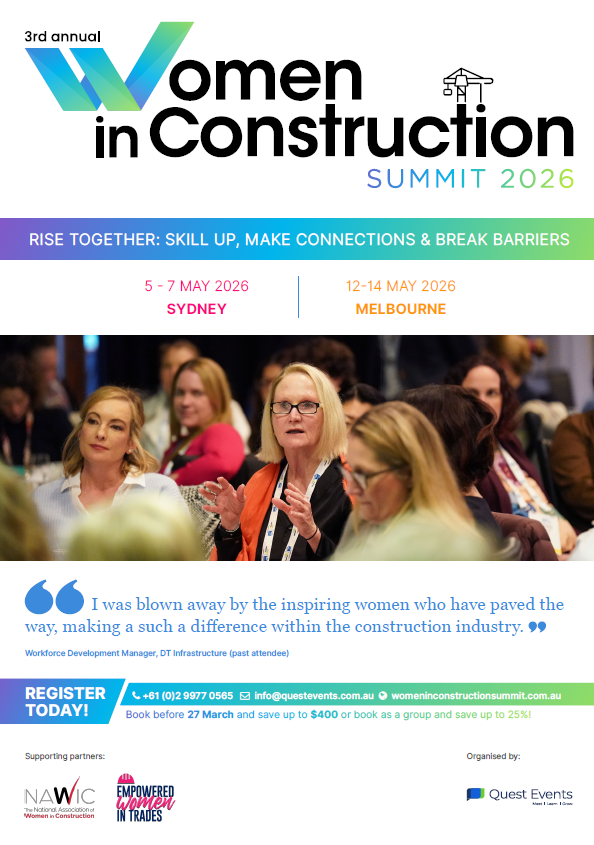
Due to popular demand, Women in Construction Summit 2026 will be held in both Sydney (5-7 May) and Melbourne (12-14 May). Attendees will hear from an inspirational line-up of industry leaders including Cathryn Greville (Melbourne event), along with interactive roundtables, group problem-solving sessions, facilitated connection building, career-defining masterclasses, and much more.
Download the Brochure